Most pizzerias don’t have an online ordering setup. They have a row of tablets, a website link nobody has touched in a year, and a Google listing that sends hungry customers to whichever app got there first. Here is what the right setup looks like, layer by layer.
The TL;DR
The best online ordering setup for a pizzeria is a hybrid. Commission-free ordering on your own website and branded app, built into your POS, is the home base. DoorDash, Uber Eats, and Grubhub feed the same system as a discovery channel.
Marketplace delivery commissions run 15% to 30% in 2026. On a $40 order, that is $6 to $12 gone before the pie leaves the oven. Your own channel carries no commission.
Online ordering is already core revenue. About 84% of pizzerias take online orders, and for those operators it averages 26.9% of sales.
Six layers make the setup work: pizza-native menu logic, a branded app with loyalty, Google pointed at your own link, integrated marketplaces, a kitchen and delivery operation that can keep up, and customer data you own.
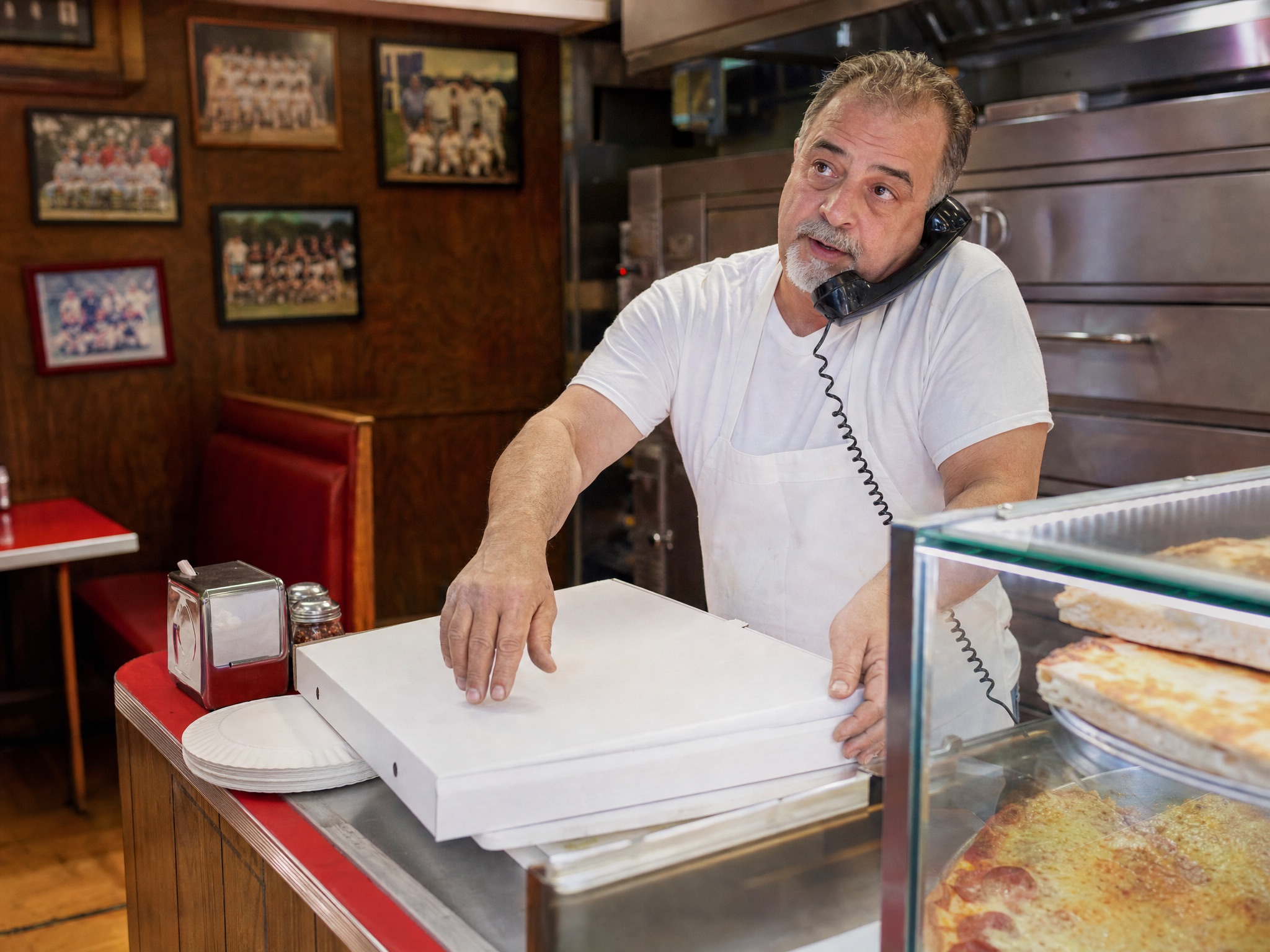
Saturday, 6:15 PM. Three tablets sit on the front counter, each one chirping on its own schedule. A cashier reads a marketplace order off one screen and keys it into the POS by hand: large, half sausage, half green pepper, well done. She misses the well done. Twenty minutes later a driver who doesn’t work for the shop is at the counter checking his phone, and the customer’s confirmation, receipt, and next reorder all run through someone else’s app.
Meanwhile, the shop’s own ordering link sits below two marketplaces on its Google listing.
That counter is what online ordering looks like at a lot of pizzerias. Orders come in, so it technically works. It just isn’t a setup. A setup is a deliberate decision about where orders should come from, what each one costs, and who keeps the customer afterward.
The Short Answer: Own the Home Base, Rent the Reach
The best online ordering setup for a pizzeria is a hybrid. Your own commission-free ordering, on your website and in a branded app, runs natively inside your POS and serves as the home base. Third-party marketplaces like DoorDash, Uber Eats, and Grubhub stay in the mix as a discovery channel, with their orders flowing into the same system instead of onto separate tablets.
Everything else is built to move customers from the marketplace to the home base: your Google listing, your loyalty program, your box inserts, your follow-up texts. The six layers below cover each piece.
Why Your Own Channel Has to Be the Home Base
Online ordering stopped being a side channel a while ago. In Pizza Today’s 2026 industry trends survey, roughly 84% of pizzeria operators reported sales from online ordering, averaging 26.9% of their sales. More than 18% said online orders made up over 45% of total sales.
26.9%
Average share of sales from online ordering among pizzerias that take online orders. For nearly one in five operators surveyed, it tops 45%.
Customers are ready to order from you directly. The same report cites consumer research showing 64% of people prefer to place delivery or takeout orders digitally. A survey of more than 1,000 restaurant customers by an ordering technology firm found 71% prefer ordering directly from a restaurant’s own website or app over a third-party marketplace.
The bigger reason is ownership. When a customer orders through your channel, you get their name, phone number, email, and order history. When they order through a marketplace, the platform keeps that relationship. You can’t text them a reorder reminder, and you can’t tell whether they are a regular or a one-time order. A channel you can’t market to is a channel you rent.
What Marketplace Orders Actually Cost in 2026
Marketplace commission rates moved up this year. DoorDash charges 15%, 25%, or 30% on delivery orders depending on the plan, and 6% on pickup. Uber Eats raised its Lite tier from 15% to 20% on March 11, 2026, kept Plus at 25% and Premium at 30%, raised pickup from 6% to 7% for stores with matching in-store pricing, and now charges 30% on Plus-tier orders from Uber One members. Grubhub runs its own tiered plans.
Usage is real. Pizza Today found that over 46% of operators use third-party delivery, and those apps account for 12.4% of overall sales. About 31% of operators get 16% or more of their sales from them.
| Channel and plan | Delivery commission | On a $40 order* |
|---|
| DoorDash Basic | 15% | −$6.00 |
| Uber Eats Lite | 20% | −$8.00 |
| DoorDash Plus / Uber Eats Plus | 25% | −$10.00 |
| DoorDash Premier / Uber Eats Premium | 30% | −$12.00 |
| Your own online ordering | None | $0.00 |
*Illustrative math on commission only. Card processing applies to every channel, including your own. Rates vary by plan and market, so confirm current terms in your merchant portal.
None of that makes marketplaces a mistake. It makes them a marketing expense, and a marketing expense has to earn its keep. We broke down that math in how to win with third-party delivery apps. The setup below is how you make sure it does.
Layer 1: An Ordering Site That Actually Understands Pizza
Pizza is one of the hardest menus to sell online. A single order can carry a size, a crust, half-and-half toppings, light sauce on one side, a well-done bake, and a deal that bundles two pies with wings and a two-liter. Generic online ordering flattens that into a “special instructions” box, and the kitchen ends up reading notes at 6:30 on a Friday.
Your ordering site should handle all of it the way your counter does. Look for:
- Native to the POS. No middleware, no re-keying, no sync lag. A web order should hit the kitchen exactly like a counter order.
- Real pizza logic. Half-and-half pricing, size and crust rules, specialty modifiers, and meal deals that price themselves correctly.
- Few taps on a phone. Assume the customer is ordering one-handed from the couch. Saved favorites, quick reorder, and a short path from menu to paid matter more than design flourishes.
- Smart add-ons. Wings, knots, and drinks suggested at the right moment raise the ticket without a hard sell.
- No surprise fees. Service fees are a big part of why customers grumble about marketplaces. Don’t rebuild that experience on your own site.
- Your brand and your languages. Your logo, your photos, your menu descriptions, and a Spanish option if your neighborhood needs one.
In Adora, online ordering is built into the POS itself, so a web order arrives in the kitchen looking identical to an in-store ticket, half-and-halfs included. The latest version of Adora’s ordering platform was designed specifically to lift average ticket size, and there are no customer fees that discourage people from ordering direct.
Layer 2: A Branded App for Your Regulars
Your website catches first-time and occasional customers. Your regulars, the family that orders every Friday, deserve something faster: a branded app with one-tap reorder and points that build toward something.
Loyalty is the strongest reason a customer has to skip the marketplace. Circana research cited by Pizza Today found loyalty members make 22% more visits than non-members. Operators are acting on it: loyalty systems ranked among the top technology purchases pizzerias made in the past year.
Domino’s shows how far that idea goes. The chain ended 2025 with 37.3 million active Domino’s Rewards members, and when it joined DoorDash’s marketplace, it kept Rewards available only on its own ordering platforms. The marketplace finds the customer. The loyalty program gives them a reason to come home.
Adora supports branded iOS and Android ordering apps, with loyalty that stays in sync across online and in-store orders. A guest earns the same points whether they tap the app or walk up to the counter.
The marketplace finds the customer. Your loyalty program gives them a reason to come home.
Layer 3: Google Pointed at Your Own Link
For a lot of customers, the ordering journey starts with a search for “pizza near me” and a tap on the Order online button in your Google Business Profile. If you haven’t set that button up, Google fills it for you. Third-party providers that say they have an authorized relationship with your business are listed automatically.
You can take that back. Google lets restaurants add their own ordering link and mark it as preferred for pickup and delivery, and in late October 2026 it added controls for managing which third-party ordering options appear on a profile at all.
- Open your Business Profile and go to the food ordering settings.
- Add your direct ordering link if it isn’t there.
- Mark it as preferred for both pickup and delivery.
- Remove or hide any provider you don’t work with.
- Recheck it monthly. Listings drift.
Then make the same link impossible to miss everywhere else: the top of your website, your Instagram and Facebook profiles, your box tops, your receipts, and your voicemail greeting.
Every order, one system, no matter where it starts.
Adora runs native online ordering, branded apps, loyalty, marketplace orders, and delivery dispatch inside one POS built for pizza.
Schedule a Demo →
Layer 4: Marketplaces as an Integrated Acquisition Channel
The largest pizza company in the world held out against third-party apps for years. In 2025, Domino’s joined DoorDash’s marketplace nationwide, with its own drivers delivering the orders, and described the aggregator marketplace as a $1 billion opportunity. Reach matters, even at that scale.
The question is how marketplaces fit into the setup. Four rules keep them working for you:
- Kill the tablets. Marketplace orders should land in your POS, your kitchen display, and your dispatch screen alongside everything else. Re-keying orders by hand costs labor and accuracy.
- Price for the commission. Where your agreements allow it, set marketplace menu prices that account for the cut, so your own channel is visibly the better deal.
- Put a reason to come back in every box. A card with a direct-order offer turns a marketplace order into the start of a relationship.
- Measure them like ads. Track how many marketplace customers move to your own channel. A first order through an app is acquisition. A tenth order through the app is a leak.
Adora brings DoorDash, Uber Eats, and Grubhub orders onto the same dispatch screen as in-house delivery, so the counter runs one system instead of four.
Layer 5: A Kitchen and Delivery Operation That Can Keep Up
Online ordering doesn’t fail on the website. It fails in the kitchen, when 20 orders land between 6:00 and 6:10 with quote times that assume a quiet Tuesday. The back half of the setup matters as much as the front:
- A kitchen display that sorts the chaos. Orders from every channel route to the right station and get prioritized by order type, so a delivery ticket and a walk-in slice don’t fight for the same spot.
- Honest ready times. A 45-minute quote that arrives in 40 earns a repeat order. A 25-minute quote that arrives in 50 earns a review.
- Scheduled orders. Let customers order now for 6:30 tomorrow. Future orders smooth out the rush and help you plan dough.
- Curbside and pickup flow. A text from the parking lot beats a crowded lobby.
- Dispatch for your own drivers. If you deliver in-house, routing and a multi-stop driver app keep direct delivery orders as fast as marketplace ones.
Layer 6: Customer Data You Own and Actually Use
Every direct order adds a name, a phone number, and a purchase history to your records. That list is the most valuable thing your online ordering produces, and most shops never touch it.
Use it. A reorder nudge to the family that hasn’t ordered in three weeks. A free side for a customer’s birthday. A text the morning of the big game. Research cited by Pizza Today found that personalized messages based on order history can make customers 72% more likely to return.
Adora keeps a unified profile for each customer across channels, and those profiles power email and SMS campaigns, coupons, and loyalty offers from the same platform that took the order.
What Changes When You Run Multiple Locations
For a growing brand, the online ordering setup has to scale without multiplying the work. The priorities shift toward control:
- One menu, managed centrally. A new specialty pie should go live at every store in one update, with store-level pricing where markets differ.
- One app for the whole brand. Customers pick a location; they don’t download a different app for each store.
- Loyalty that travels. Points earned at one location should redeem at every location.
- Reporting by store and by channel. You need to see which locations are winning direct orders and which are leaning on marketplaces.
In Adora, item names, prices, descriptions, and images can be managed at the store, franchise, or corporate level. See how that works across a brand on our multi-store features page.
A Five-Minute Audit of Your Current Setup
Before changing anything, find out where you stand. Answer these honestly:
- Search your shop on Google from your phone. Which ordering link shows up first?
- Order a half-and-half from your own site. How many taps did it take, and did the ticket print correctly?
- Count the tablets on your counter.
- What share of last month’s online orders came through your own channel versus the marketplaces?
- Could you text every customer who ordered direct in the past 90 days?
- Does your loyalty program work online, in the app, and at the counter?
If more than two answers made you wince, the fix is rarely another add-on. It is a setup where ordering, the kitchen, delivery, and loyalty run on one system that was built for pizza. You can see how Adora handles online ordering, or book a walkthrough with someone who has run a pizza counter.
Sources & Data
Pizzeria online ordering adoption (about 84% of operators, averaging 26.9% of sales; over 18% above 45%), third-party delivery usage (over 46% of operators, 12.4% of overall sales, 31.2% at 16% or more), technology purchases, consumer preference for digital ordering (64%), loyalty member visits (22% more, Circana), and personalized messaging (72% more likely to return): Pizza Today, 2026 Pizza Industry Trends Report. Preference for ordering from a restaurant’s own website or app (71%, survey of more than 1,000 restaurant customers by an ordering technology firm): C-Store Dive, August 2023. DoorDash commission tiers and 6% pickup rate: DoorDash Merchant Pricing. Uber Eats changes effective March 11, 2026, including Lite moving to 20%, pickup to 7%, and the 30% Uber One rate on Plus: Restaurant Dive. Domino’s Rewards at 37.3 million active users: Restaurant Dive via Yahoo Finance. Domino’s DoorDash partnership and the $1 billion aggregator opportunity: Domino’s Pizza, April 2, 2025; Rewards limited to Domino’s own platforms: QSR Magazine. Google ordering links and preferred providers: Google Business Profile Help; new third-party ordering controls: Search Engine Roundtable, October 28, 2026. Per-order commission dollars are illustrative arithmetic, not audited figures.