Any POS can ring up a pizza. The hard part of a delivery order starts after the card clears: an address, a promise time, a driver, and a customer watching the clock. Here’s what a delivery operation needs from its POS that a generic system was never built to do.
The TL;DR
A pizza delivery POS runs the order past the payment. It ties every ticket to an address and a delivery zone, quotes a promise time, dispatches a driver, and records the run.
The features a generic POS usually lacks: map-drawn delivery zones and fees, promise times built from live kitchen and driver capacity, one dispatch screen for in-house and third-party orders, and a driver app built for multi-stop runs.
Speed is the scorecard. In Intouch Insight’s 2026 pizza study, satisfaction began to drop once delivery passed 40 minutes, and dissatisfied customers waited an average of 59 minutes and 24 seconds.
A generic POS can be enough for a dine-in or walk-up shop that doesn’t run its own drivers. Once drivers are on your payroll, delivery logistics belong inside the POS.
Friday, 6:40 p.m., and Every Order Has an Address
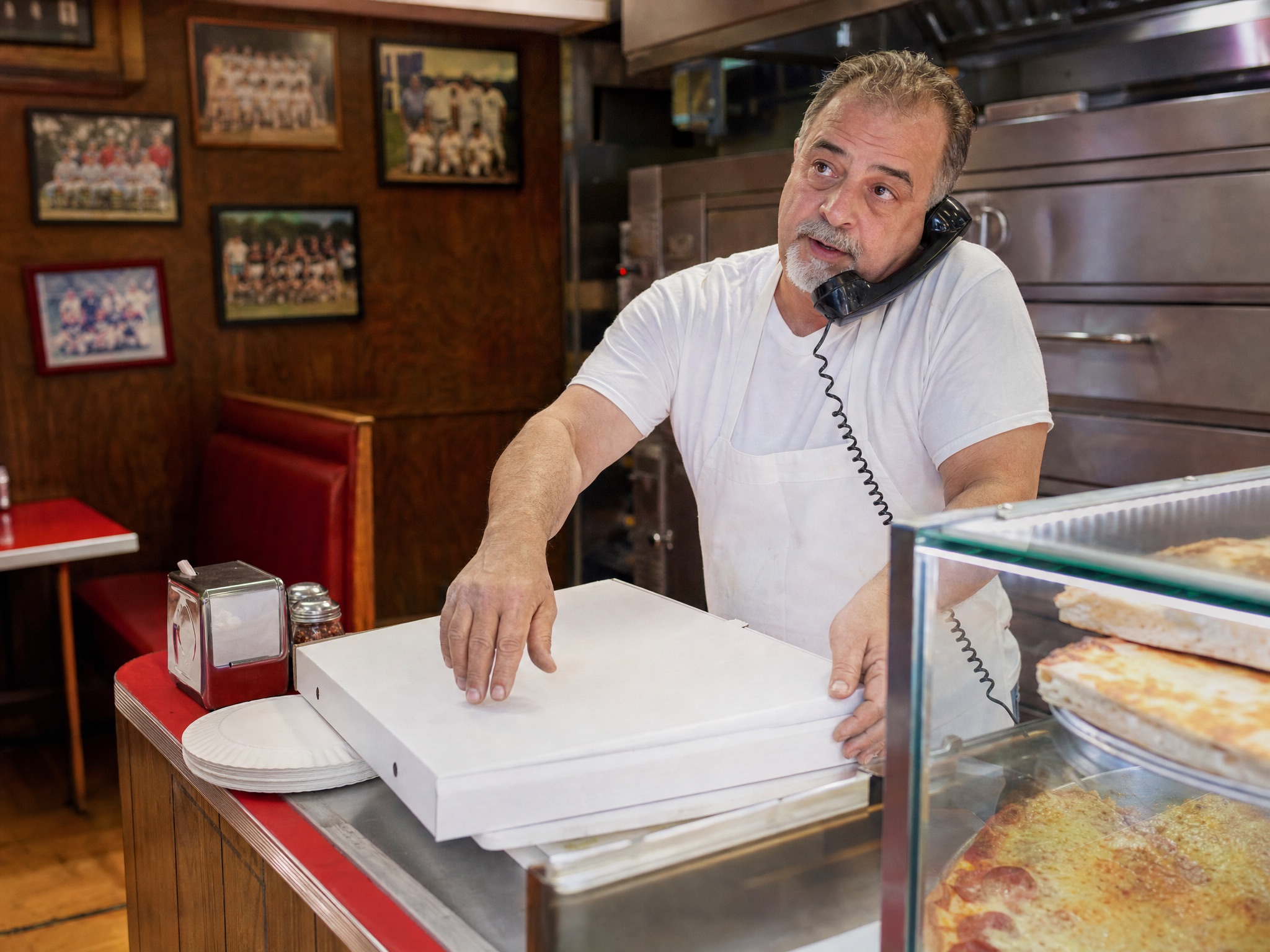
The make line is three screens deep. Two drivers are standing at the heat rack waiting on a pie that’s still in the oven. A third is somewhere on the north side with four orders in his bag, and nobody at the store is sure which stop he’s on. A delivery app tablet chimes on the counter, then a second one. The phone rings, and the first thing the caller gives is a street name.
A generic POS sees all of this as a list of paid tickets. It knows what was ordered and how it was paid for. It doesn’t know that two of those tickets are headed to the same apartment complex, that the north-side zone is running 20 minutes behind, or that the driver at the rack could take both orders in one run.
That gap is the whole question. Restaurants in general have moved off-premises, and the National Restaurant Association now puts nearly 75% of restaurant traffic outside the dining room. Pizza has lived there for decades. For a pizzeria, delivery is where margin is either protected or given away, one run at a time.
What Is a Pizza Delivery POS?
A pizza delivery POS is a point-of-sale system that manages a delivery order from the moment it’s placed to the moment it reaches the door. Beyond taking the order and the payment, it attaches the address and delivery zone, applies the right fee and minimum, quotes a promise time based on current kitchen and driver capacity, sends the order to an in-house driver or tracks it through a third-party platform, and keeps a record of every run.
A generic POS is built around the transaction. Its job ends when the payment clears. Delivery, where it exists at all, tends to arrive as an add-on, a separate dispatch tool, or a row of marketplace tablets on the counter. Each piece can work on its own. None of them sees what the kitchen and the drivers can actually handle in the next 30 minutes.
Pizza Delivery POS vs. Generic POS at a Glance
| Requirement | Typical Generic POS | Pizza Delivery POS |
|---|
| Delivery address | An optional customer field | On every delivery ticket, tied to a zone |
| Fees and minimums | One flat fee, set by hand | Set by zone and by time of day |
| Promise time | A fixed default quote | Calculated from the live queue, typical throughput, and drivers on shift |
| Third-party orders | Separate tablets, re-keyed by staff | Direct integrations into the same queue as in-house orders |
| Dispatch | A whiteboard, memory, or a bolt-on tool | Built into the POS and visible from a manager’s phone |
| Driver tools | A printed ticket and the driver’s own map app | A driver app with multi-stop routing, navigation, and tipping at the door |
| “Where’s my order?” calls | Someone walks to the back to ask | Live order and dispatch status at the phone |
| Delivery records | Rebuilt from tickets at close | Logged automatically, stop by stop |
*Generic POS capabilities vary by vendor and add-on. The middle column describes a common out-of-the-box setup.
1. Delivery Zones, Fees, and Minimums Drawn on a Map
Every delivery carries a cost that grows with distance: fuel, wear on the car, and driver time that could have gone to the next order. The IRS standard mileage rate for 2026 is 72.5 cents per mile. Used as a rough benchmark, an order four miles out is an eight-mile round trip and about $5.80 in vehicle cost before you’ve paid the driver for the time. A flat delivery fee prices that order the same as one two blocks away.
A pizza delivery POS lets you draw zones on a map and price by geography: one fee and minimum for the close-in neighborhoods, a higher fee or a larger minimum at the edges. The better systems let a zone change with the clock. During the Friday peak, a tighter radius keeps drivers turning quickly. At 2 p.m. on a Tuesday, a wider one picks up orders you’d otherwise miss. Adora sets custom delivery zones, fees, minimums, and time windows by location.
2. Promise Times Built From Live Kitchen and Driver Capacity
Customers forgive a 45-minute quote more easily than a 30-minute quote that turns into 50. Intouch Insight’s 2026 study of 600 mystery-shopped orders at 10 national pizza brands found that satisfaction began to drop once delivery passed 40 minutes.
40 minutes
The point where pizza delivery satisfaction began to fall in Intouch Insight’s 2026 study. Dissatisfied customers waited 59 minutes and 24 seconds on average.
A generic POS quotes whatever default someone typed into settings, whether the kitchen is empty or buried. A pizza delivery POS reads the conditions: how many orders are ahead in the queue, how fast this kitchen usually moves at this hour on this day, and how many drivers are actually on the clock. Adora calculates promise times from real kitchen throughput, so the quote moves when the rush does. An accurate quote won’t make the pizza faster, but it keeps a long night from turning into a pile of refunds.
3. One Dispatch Screen for In-House and Third-Party Orders
Plenty of pizzerias don’t choose between their own drivers and the delivery apps. They run both. Pizza Today’s 2026 Pizza Industry Trends Report found that more than 46% of operators surveyed use third-party delivery, and the channel accounts for 12.4% of their overall sales.
When those orders arrive on separate tablets, someone has to re-key them, and every re-key is another chance to drop a topping or miss a modifier. The bigger problem is that the kitchen can’t see the whole load. A marketplace order due at 6:45 and an in-house order due at 6:45 are competing for the same oven, and a generic setup treats them as two separate businesses.
A pizza delivery POS puts every delivery in one queue. Adora’s direct DoorDash, Uber Eats, and Grubhub integrations land each marketplace order in the POS with the full ticket, customer details, delivery address, and marketplace fee already calculated, on the same screen as your own drivers. The fee matters. DoorDash’s published delivery commissions run 15%, 25%, or 30% of the subtotal depending on the plan, so a marketplace order and a direct order of the same size don’t carry the same margin, and your POS should show the difference.
A generic POS is finished when the payment clears. A delivery order still has an address, a promise time, and a driver ahead of it.
4. A Driver App Built for Multi-Stop Runs
Drivers own the last stretch of every delivery order, and in most generic setups they work it with a printed ticket and their own phone. They copy addresses into a map app, decide the stop order themselves, and call the store when something goes sideways.
That last stretch is where delivery quality is won or lost. In Intouch Insight’s 2026 study, chains using only their own drivers delivered 8 minutes and 18 seconds faster than chains that frequently used third-party drivers. Third-party drivers also skipped the insulated bag on most of the orders they carried, and at mid-sized chains, food temperature scores fell from 100% with a bag to 74% without one.
64%
Share of third-party-fulfilled orders in Intouch Insight’s 2026 pizza study where the driver didn’t use an insulated pizza bag.
Your own drivers deserve tools that match the job. The Adora Connect driver app shows each order with the customer name, address, and special instructions, opens one-tap navigation in Apple Maps or Google Maps, sequences multi-stop routes, and lets customers add a tip at the door. Each stop is recorded the moment the driver marks it complete. We covered how routing changes the economics of a run in Driver App: Why the Last Mile Needs Its Own Operating System.
See every delivery, in-house and third-party, on one screen.
Watch Adora quote promise times from real kitchen throughput, route multi-stop runs in the driver app, and pull DoorDash, Uber Eats, and Grubhub orders into the same queue.
Schedule a Demo →
5. Live Order Status for Whoever Answers the Phone
“Where’s my pizza?” is the most expensive call in the building. It ties up a line in the middle of the rush, and if the answer is a guess, it can cost you the customer too. Intouch Insight found that ordering apps with real-time order tracking scored 6.1 percentage points higher on satisfaction with speed of service.
Whether the customer checks a tracker or picks up the phone, the answer should come from live dispatch data: which driver has the order and where it sits in the route. Adora shows that status in the POS, and its web-based call center gives phone staff live visibility into order status and dispatch, with single-number routing across locations for brands that centralize their calls. Our pizza call center software guide walks through how that works for multi-unit chains.
6. Customer and Address History That Travels With the Order
Delivery customers repeat themselves. Same address, same gate code, same “leave it on the porch,” and often the same half-and-half. A generic POS may store a name and a phone number. A delivery operation needs history attached to the order: past orders for quick reordering, delivery notes that show up on the driver’s screen, and one customer profile whether the order comes in online, by phone, or at the counter.
That profile has to be the same everywhere because digital is now a large share of the business. Pizza Today found that 84% of operators surveyed take online orders, and those orders average 26.9% of sales. Adora’s online ordering is native to the POS, with order history and one-tap reordering for guests, and customer profiles are shared across locations.
7. Delivery Records and Multi-Store Visibility
At close, a delivery operation needs answers a generic POS rarely keeps: how many runs each driver made, how many stops went out per run, and when each order actually reached the door. Those numbers drive scheduling, zone changes, and driver pay. Rebuilt from paper tickets, they’re estimates.
A pizza delivery POS logs every delivery and stop as it happens. Adora records each completion in real time and puts dispatch monitoring on the POS and on a manager’s phone, so a district manager covering several stores can spot a backup at one location before customers start calling about it.
Questions to Ask Any POS Vendor About Delivery
Every POS demo looks good on a slow afternoon. These questions show you what the system does on a Friday night.
- Third-party orders. Do DoorDash, Uber Eats, and Grubhub orders arrive through a direct integration, or through tablets my staff has to re-key?
- Promise times. How is the quote calculated, and does it change on its own during a rush?
- Zones and fees. Can I draw delivery zones on a map and set fees, minimums, and hours for each one?
- Drivers. Is there a driver app, and does it handle multi-stop routes and tips at the door?
- Driver settlement. How do drivers close out cash and tips at the end of a shift, and what delivery and mileage records does the system keep?
- Phone orders. Where does the person answering the phone see live order and driver status?
- Oversight. Can a manager watch dispatch from a phone, across every store?
When Is a Generic POS Enough?
If you run a dine-in or walk-up slice shop, don’t employ drivers, and take delivery only through a marketplace tablet, a generic POS may cover you. The delivery app handles the driver, the route, and the customer updates, and your POS only has to ring the order.
The math changes the day you put your own drivers on the schedule. From then on you own the promise time, the route, the zone, and the customer’s experience at the door, and each of those runs on data a generic POS doesn’t keep. For the broader comparison beyond delivery, see Pizza POS vs. Generic Restaurant POS.
Delivery Gets Harder With Every Store
One store can run delivery on a whiteboard and a sharp manager. Five stores can’t. Each new location adds zones to price, drivers to schedule, and marketplace accounts to reconcile, and the problems stop being visible from any single counter.
Adora was built inside a pizza chain and runs pizza brands from a single shop to more than 1,200 locations, with delivery dispatch, a driver app, online ordering, and a call center on the same cloud platform as the POS. If delivery is a real part of your business, schedule a demo and watch a Friday rush run on one screen.
Sources & Data
Nearly 75% of restaurant traffic happening off-premises: National Restaurant Association, Off-Premises Restaurant Trends 2025. 2026 business standard mileage rate of 72.5 cents per mile: Internal Revenue Service, IR-2025-128; the $5.80 round-trip figure is an illustrative calculation at that rate, not a measured delivery cost. Satisfaction dropping past 40 minutes, the 59-minute-24-second average wait among dissatisfied customers, the 8-minute-18-second speed advantage for chains using only their own drivers, and the 6.1-point speed-satisfaction gain from real-time tracking: Intouch Insight, 2026 Pizza DELCO Study. Third-party drivers skipping insulated bags on 64% of third-party-fulfilled orders, and mid-sized chain temperature scores falling from 100% to 74% without a bag: Intouch Insight release via GlobeNewswire. The Intouch study covered 600 mystery-shopped orders across 10 national and regional pizza brands, placed directly by phone or app in September and October 2025, so results may differ for independent operators. Third-party usage (more than 46% of operators, 12.4% of overall sales) and online ordering (84% of operators, averaging 26.9% of sales): Pizza Today, 2026 Pizza Industry Trends Report. DoorDash delivery commissions of 15%, 25%, and 30% by plan: DoorDash Merchant Pricing.