
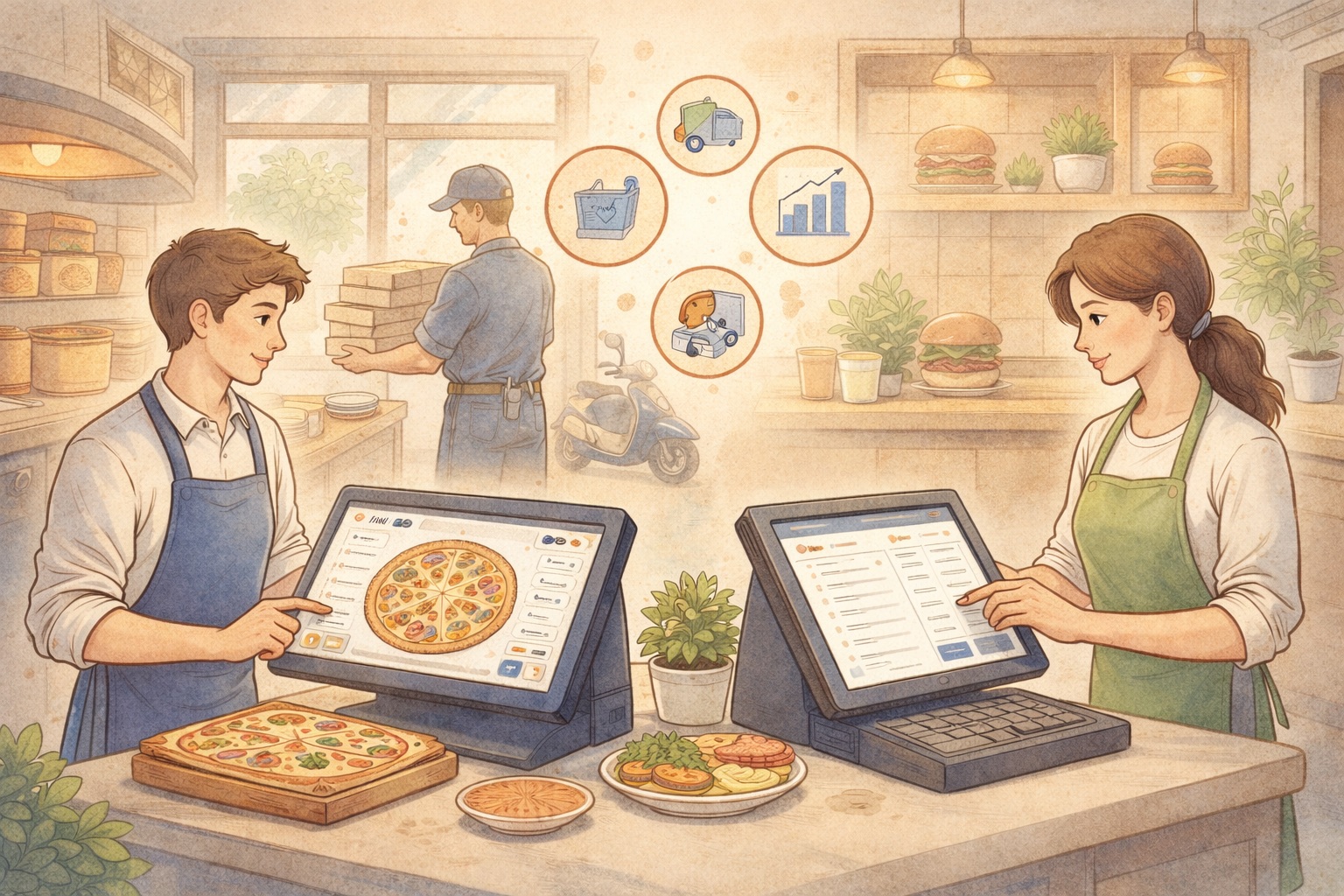
Pizza POS vs Traditional POS: What Every Pizzeria Owner Should Know
RESTAURANT TECHNOLOGY
Choosing the right point-of-sale system is one of the most important decisions a pizzeria owner can make. Your POS touches nearly every part of your operation, including order entry, payments, delivery coordination, customer experience, reporting, and long-term scalability. While many restaurants rely on traditional POS systems built for general food service, pizzerias operate differently, and those differences have a direct impact on speed, accuracy, and profitability.
Understanding the difference between a pizza POS and a traditional POS helps pizzeria owners avoid common technology mistakes and choose a system that actually supports how pizza restaurants run day to day.
What Is a Traditional POS System?
A traditional POS system is designed to serve many types of restaurants, such as cafés, quick-service concepts, bars, and casual dining. These systems usually focus on a core set of features:
- Basic order entry
- Payment processing
- Menu management
- Standard sales reports
For restaurants with simple menus and minimal customization, this approach can be enough. However, most pizzerias quickly run into limitations. As order volume increases, customization becomes more detailed, and delivery becomes a larger share of sales, traditional POS systems often struggle to keep up. What works for a sandwich shop or café doesn’t always translate well to a pizza-focused operation.
What Is a Pizza POS System?
A pizza POS system is purpose-built specifically for pizza restaurants. Instead of forcing pizza workflows into a generic structure, a pizza POS is designed around how pizzerias actually operate. This includes customizable pies, delivery timing, customer history, and high-volume rush periods.
A modern pizzeria POS supports:
- Pizza sizes, crust types, toppings, halves, and modifiers
- Fast order entry during peak hours
- Delivery-first workflows
- Repeat customer tracking and saved orders
Because the system mirrors real pizza operations, staff can work faster with fewer errors, and owners gain better visibility into their business.
Pizza POS vs Traditional POS: Key Differences That Matter
Order Customization
Pizza orders are rarely simple. Customers expect full customization, and during busy periods, staff need to enter those orders quickly and accurately. Traditional POS systems often rely on generic modifiers that slow down order entry and increase mistakes. Pizza POS systems are designed to handle complex builds intuitively, making customization faster and more reliable.
Delivery Management
Delivery is a major revenue driver for many pizzerias. Traditional POS systems often treat delivery as an add-on feature, requiring workarounds or separate tools. A pizza POS integrates delivery directly into the workflow, helping teams manage dispatch timing, driver assignments, and order status more efficiently.
Speed During Rush Periods
Friday nights, weekends, and events demand speed. Pizza POS systems are optimized for high order volume and rapid kitchen communication. Traditional POS systems can slow down under pressure, creating bottlenecks at the front counter and in the kitchen.
Customer Data and Repeat Orders
Pizzerias rely heavily on repeat customers. A pizza POS stores customer profiles, order history, and preferences, making reordering faster and improving customer service. Traditional POS systems often provide limited customer tracking, making it harder to build loyalty.
Reporting and Insights
Generic reports don’t always answer pizza-specific questions. A pizza POS delivers insights tailored to pizzerias, such as:
- Peak ordering times
- Delivery performance
- Best-selling pizzas
- Operational inefficiencies
These insights help owners make smarter decisions that directly impact profitability.
Why a Pizza POS Gives Pizzerias a Competitive Advantage
A pizza POS system does more than process transactions, it becomes the operational backbone of the business. By aligning technology with real pizza workflows, a pizzeria POS helps reduce order errors, improve delivery coordination, and create a smoother experience for both staff and customers.
Over time, these benefits compound. Faster service leads to happier customers. Better data leads to smarter decisions. Fewer errors lead to lower costs. For growing pizzerias or multi-location operators, a pizza POS also provides the consistency and scalability needed to expand without operational chaos.
When a Traditional POS Might Still Work
In some limited cases, a traditional POS may be enough. Very small pizza shops with minimal customization, little to no delivery, and low order volume may be able to operate effectively with a general-purpose system. However, as soon as delivery demand increases or order complexity grows, the limitations of a traditional POS become clear, often during the busiest and most stressful times.
Frequently Asked Questions About Pizza POS Systems
What makes a pizza POS different from a regular POS?
A pizza POS is built specifically for pizza restaurant workflows, including customizable pies, delivery operations, and repeat customer ordering. A regular POS is designed for general restaurant use.
Is a pizza POS system only for delivery-focused pizzerias?
No. While delivery is a major advantage, dine-in and carryout pizzerias also benefit from faster order entry, better customization tools, and improved customer data.
Can a pizza POS help reduce order mistakes?
Yes. Pizza-specific interfaces and structured customization reduce manual entry errors that are common with traditional POS systems.
Is a pizza POS more expensive than a traditional POS?
Not necessarily. Many pizza POS systems save money over time by improving efficiency, reducing errors, and increasing repeat business.
How do I know when it’s time to switch to a pizza POS?
If your staff struggles during rush periods, delivery feels disorganized, or order mistakes are increasing, your pizzeria has likely outgrown a traditional POS.
Final Thoughts
The difference between a pizza POS and a traditional POS isn’t just about features, it’s about fit. Pizzerias operate in a fast-paced, customization-heavy, delivery-driven environment that requires technology built specifically for those challenges. For owners who want smoother operations, better customer experiences, and sustainable growth, choosing the right pizzeria POS system is essential.
Read more
See all articles
How to Open a Second Pizzeria Location: A Step-by-Step Checklist
RESTAURANT TIPS
Advice by the Slice: Detroit Style Pizza Is Having Its Moment
RESTAURANT TIPS

Staggered POS Contracts: How They Lock You In and How to Get Out
RESTAURANT TIPS